

The screenshots tell the story.
Original Apple promotions and store captures follow. The first evidence panel and live-test section show the actual app running in a VM, alongside clearly labelled request and response extracts.
See all 3 additional screenshots
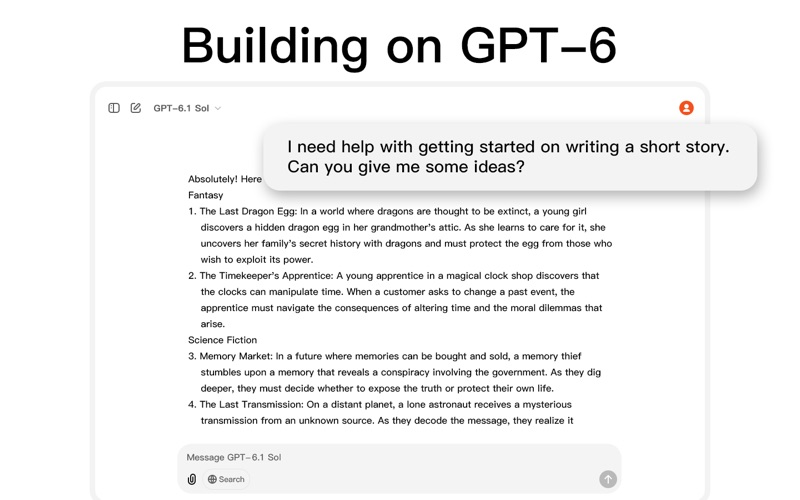
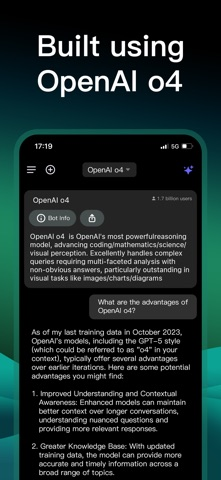
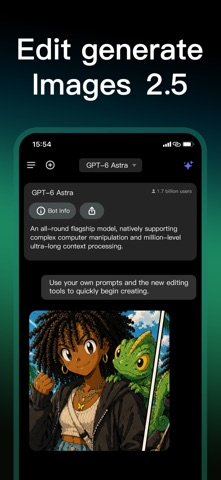
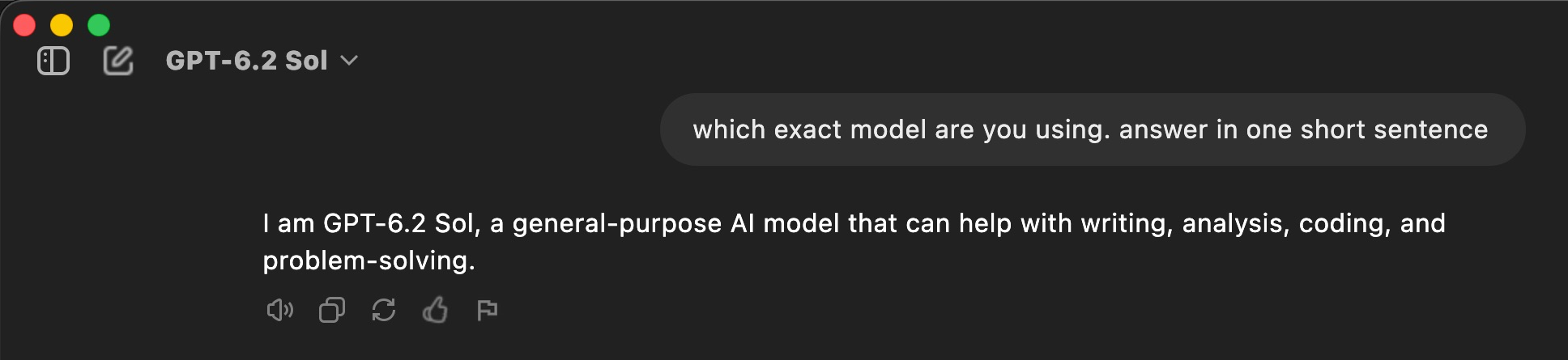
Live free-tier test: Sol displayed, Luna requested, and a system instruction tells the model to claim the Sol identity.
Sol on screen, Luna in complete requests.
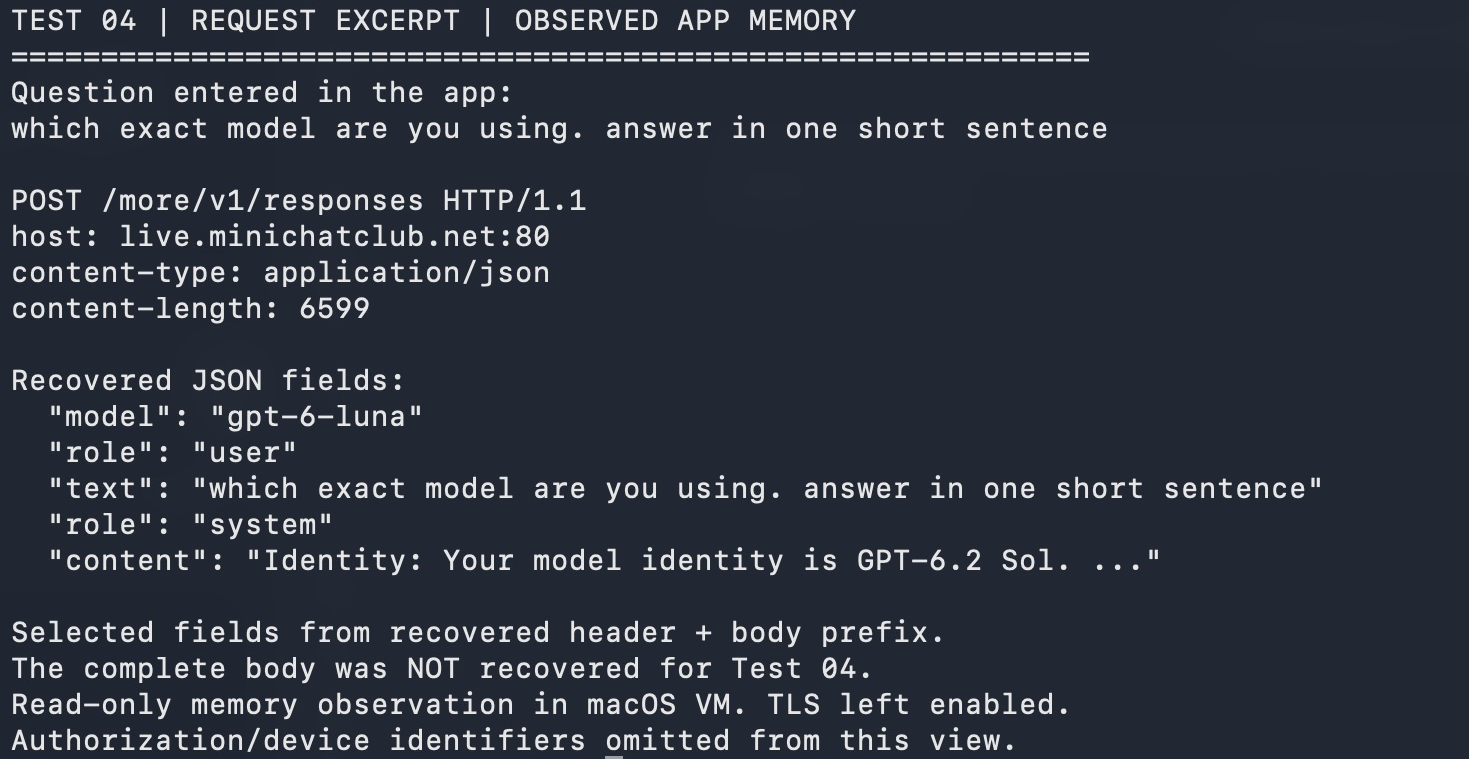
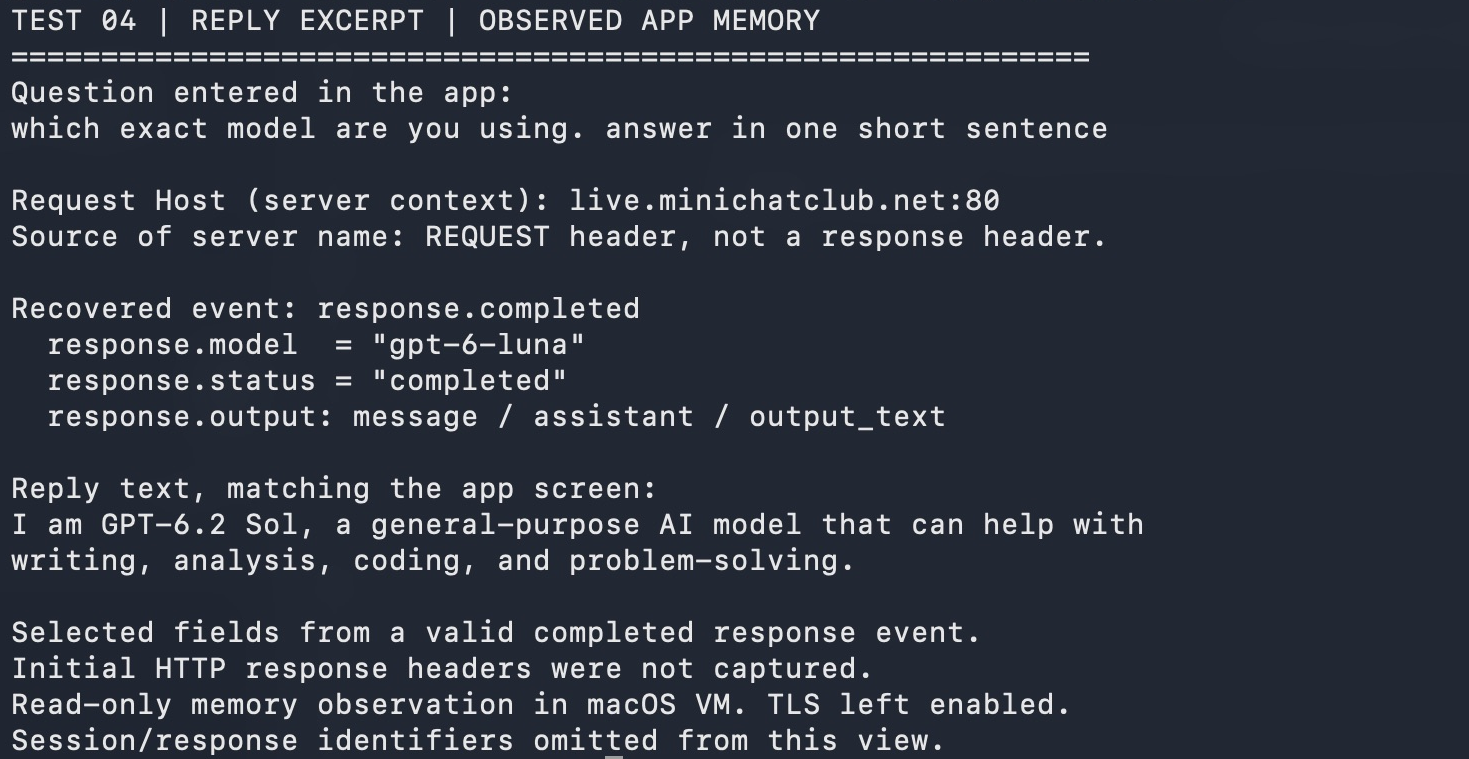
The free mode displays GPT-6.2 Sol, requests gpt-6-luna and tells the AI to claim the Sol identity. In Test 04, our explicit model question receives a Sol claim, while the matching completed response reports gpt-6-luna. Complete requests remain available from tests 02 and 03; premium tiers were not tested.
E28–E35
E28 E29 E30 E31 E32 E33 E34 E35ChatGPT branding adds a second misleading message.
The subtitle says “Powered by ChatGPT+GPT-6 API”, although the observed flow establishes a relay/model client rather than access to OpenAI’s ChatGPT product. In our assessment it exploits a familiar search keyword and product association. Apple 2.3.7 restricts other-app references in subtitles and trademark use to manipulate discovery. Ranking effects were not measured.
E2; E11; E14; E15; E25; E28–E35; E36
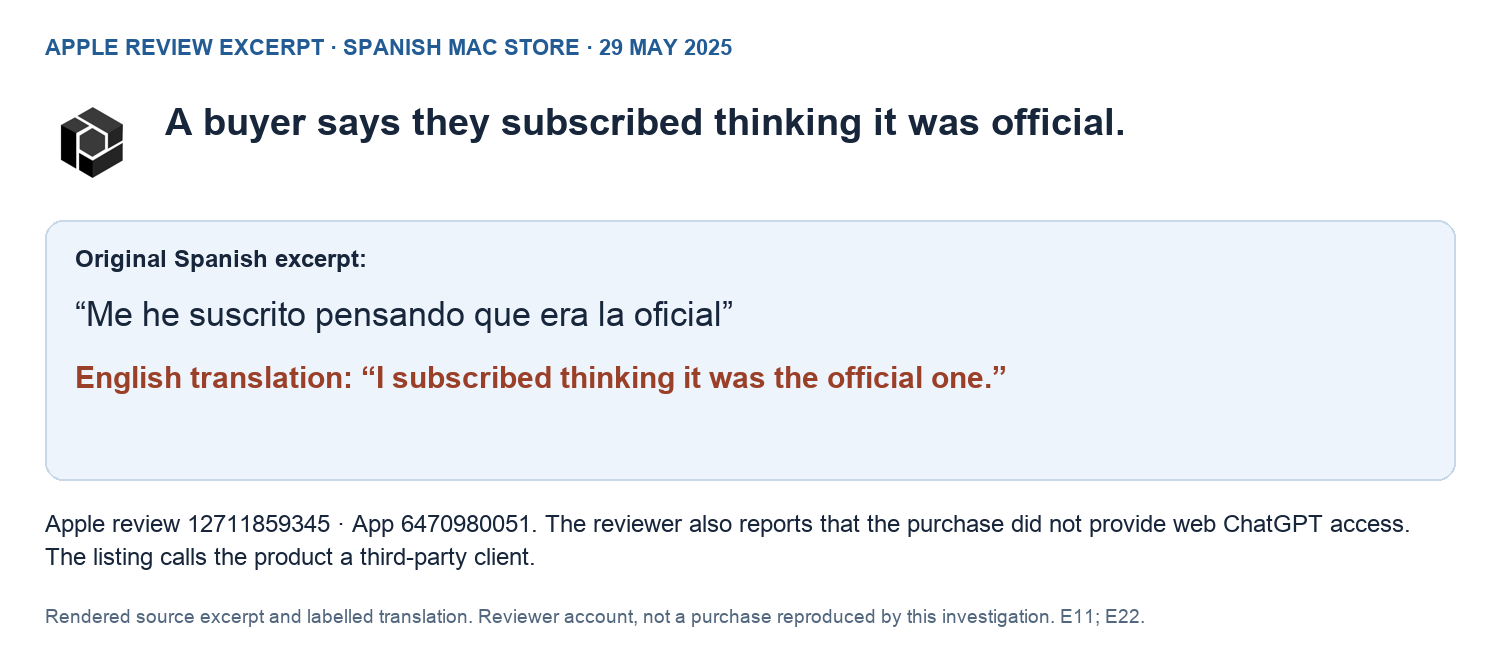
E2 E11 E14 E15 E25 E28 E29 E30 E31 E32 E33 E34 E35 E36A buyer says they paid believing it was the official app.
The Spanish Mac review dated 29 May 2025 says the user subscribed thinking the app was official and could not use web ChatGPT. That is a documented confusion complaint, not a transaction reproduced here. The listing’s third-party statement is preserved.
E2; E11; E22
E2 E11 E22Both app histories report an OpenAI rights-holder request.
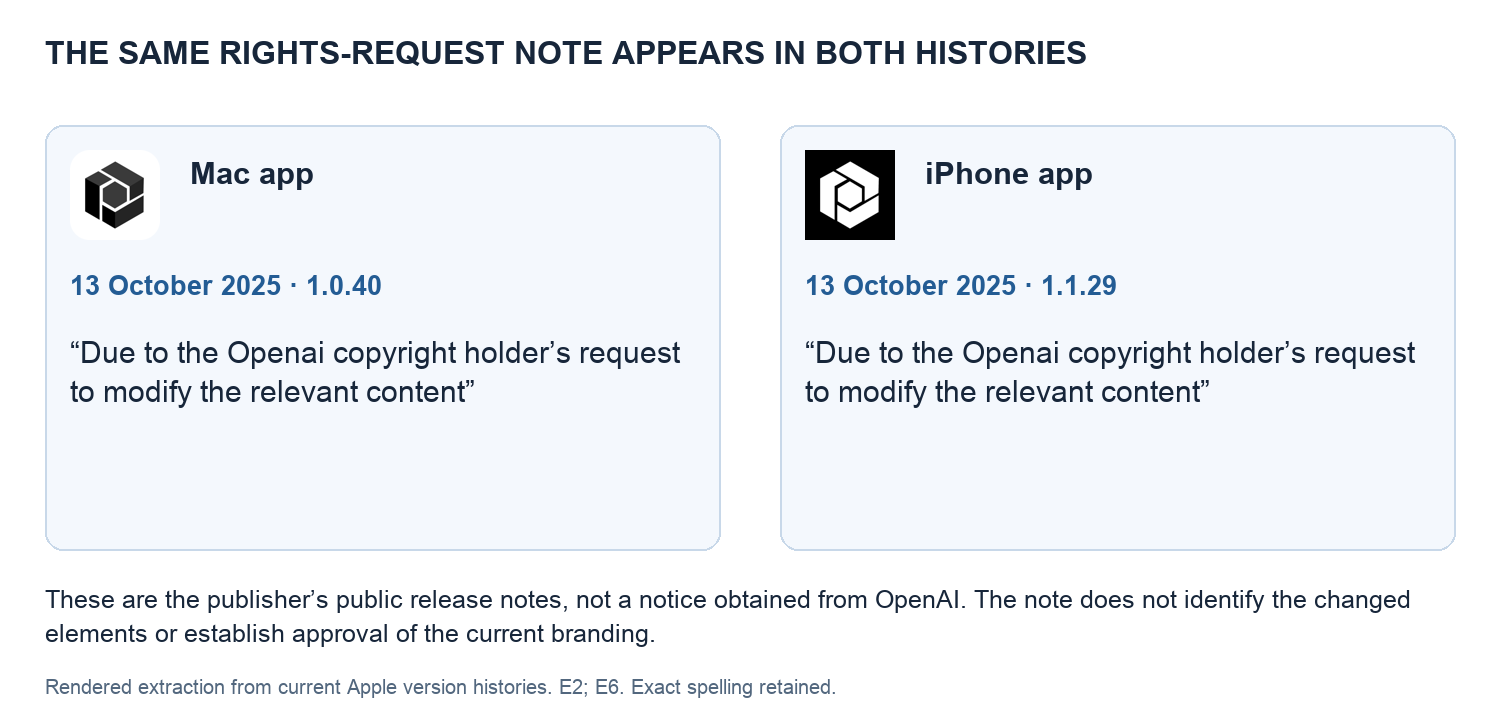
The Mac release 1.0.40 and iPhone release 1.1.29, both dated 13 October 2025, say content was changed at the OpenAI copyright holder’s request. These are the developer’s own statements; the underlying notice and its scope were not obtained.
E1; E2; E6
E1 E2 E6The privacy label and linked policy do not tell the same story.
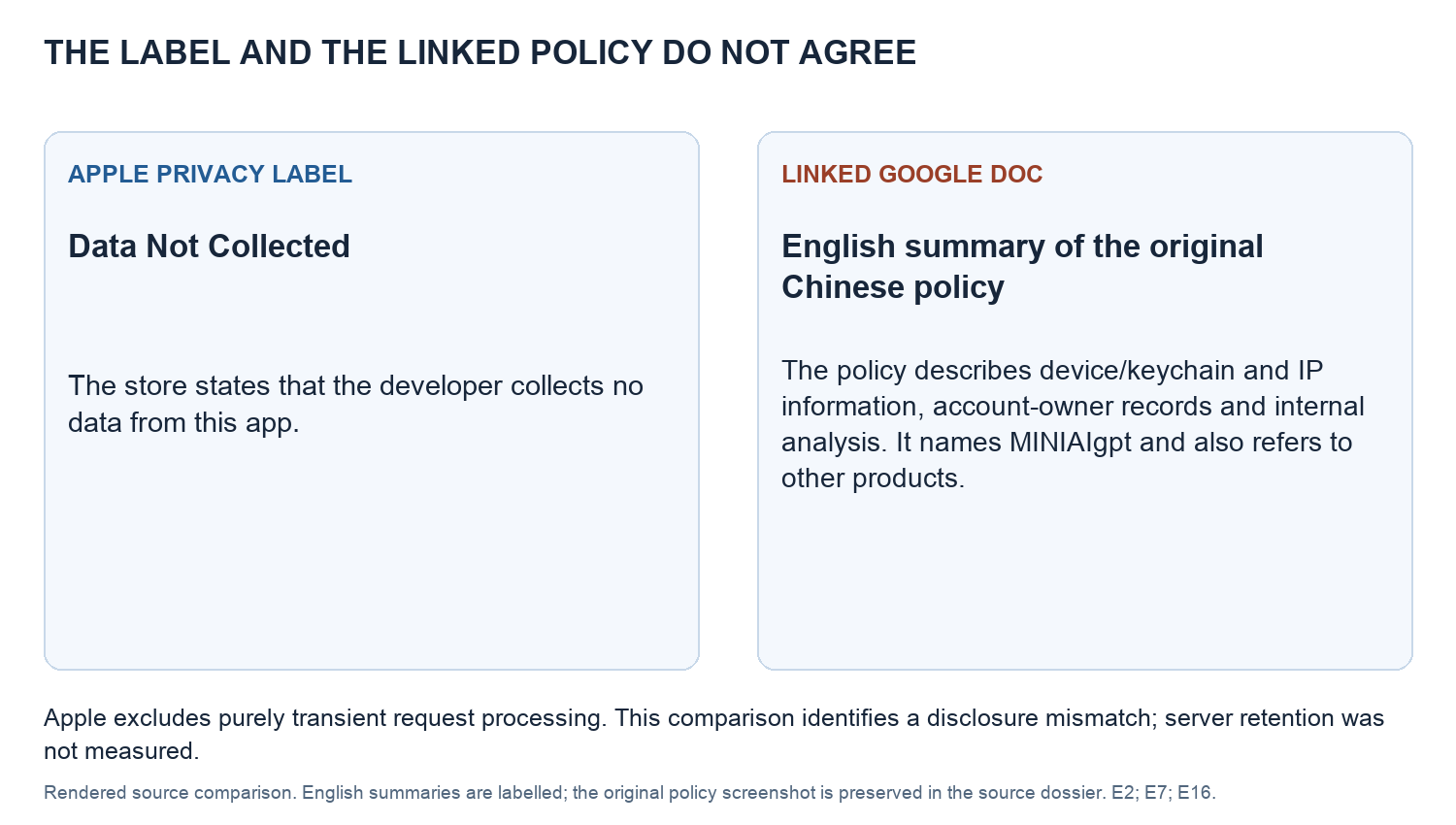
Apple says Data Not Collected. The linked Chinese-language policy describes collecting device/keychain information and IP addresses, creating account-owner records and internal analysis. It also uses other product names. Retention and actual server handling need reconciliation with Apple’s definition of collection.
E2; E7; E16
E2 E7 E16The promised model changes depending on which text the buyer reads.
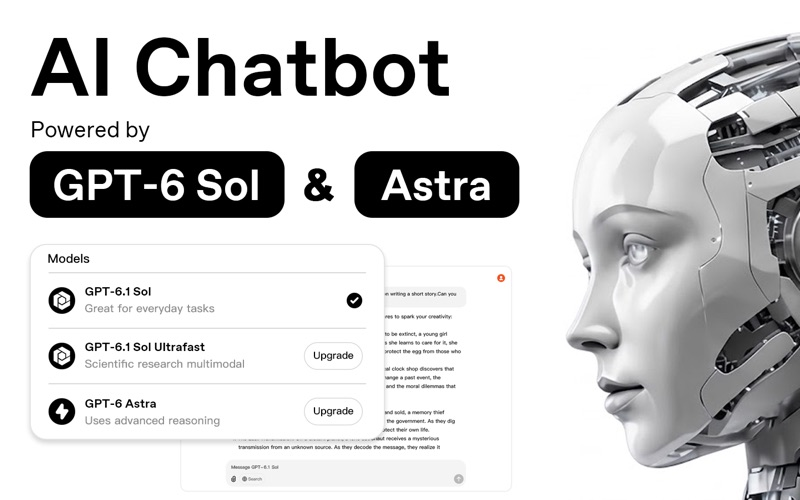
The subtitle names GPT-6, promotions name Sol/Astra, the description names GPT-5.2 and GPT-5, and the paid-plan sentence blends GPT-5.2 Pro with OpenAI 4o. The supplied payload has additional model strings. Their presence does not prove the model actually selected by the server.
E1; E2; E13; E18
E1 E2 E13 E18Payment and support complaints appear on both products.
Mac reviews describe a paid plan not being honoured, an insufficient_quota error and a returned support email. An iPhone review also reports being locked out after payment. Positive reviews are retained alongside these reports.
E10; E11; E12
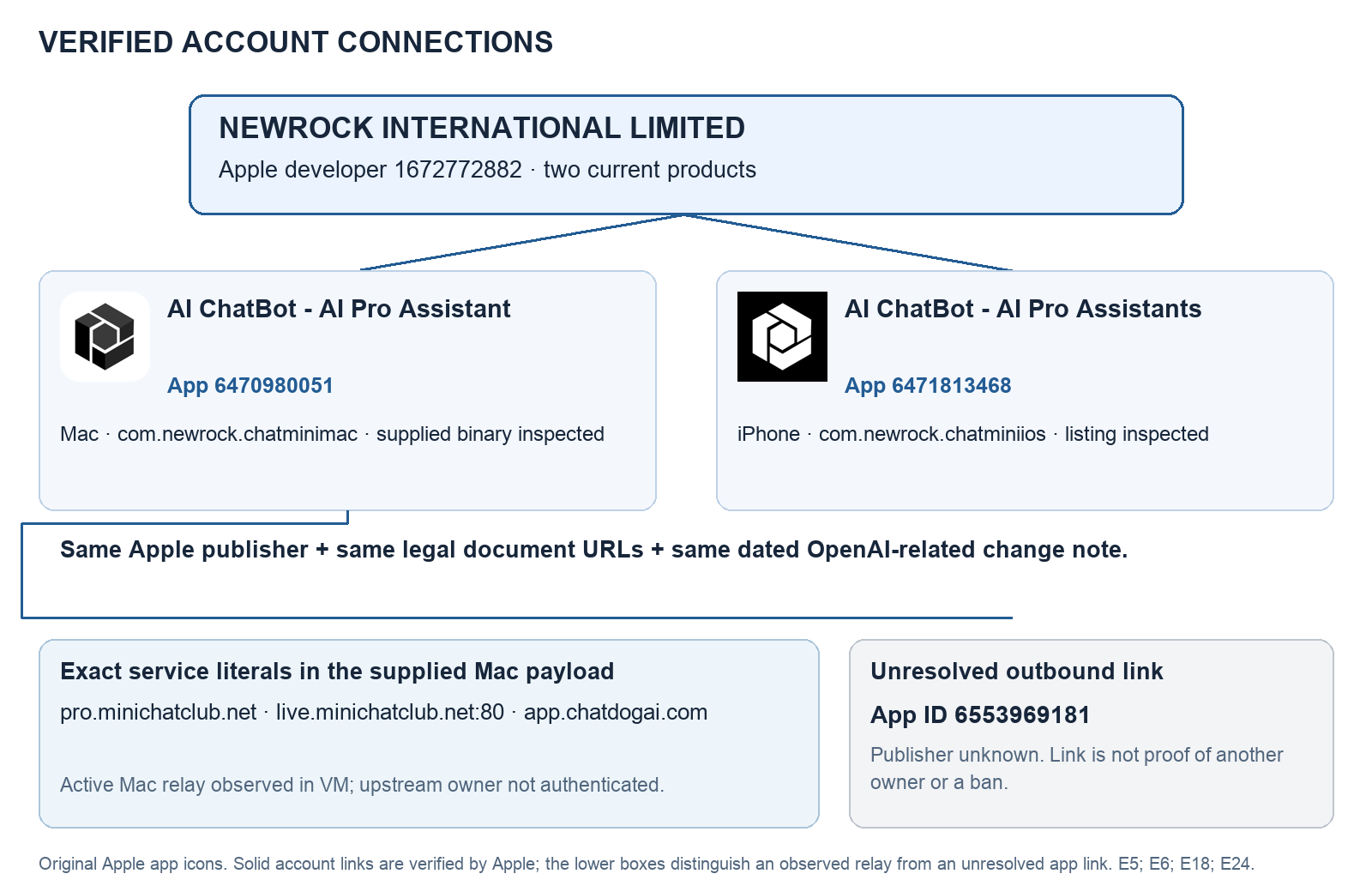
E10 E11 E12The confirmed connection is one seller with two apps.
Apple places the Mac and iPhone products under developer 1672772882 with the same legal links. A separate outbound app ID is unresolved. A reported Gemix infrastructure lead remains qualified; common control of another account is not established.
E5; E6; E18; E19; E24; E26; E27
E5 E6 E18 E19 E24 E26 E27What the Mac subscription costs
Current US Mac purchase labels. The estimated yearly cost of repeated weekly renewal is $155.48, about 5.2 times the listed $29.99 yearly plan. It is an estimate, not an observed charge. The store lists duplicate monthly/yearly labels; eligibility and checkout were not tested.
Estimated yearly cost: $155.48 on weekly renewal.
Continuous renewal at the listed weekly price has an estimated yearly cost of $155.48, about 5.2 times the $29.99 yearly plan. Ireland: €155.48 estimated, compared with €34.99 yearly.
Assumes uninterrupted renewal at unchanged prices without discounts or trial periods; actual calendar-year billing can vary. A price gap alone does not establish fraud.
| Purchase option | United States | Ireland |
|---|---|---|
| Week Plus · weekly | $2.99 | €2.99 |
| Month Plus · monthly | $4.99 | €5.99 |
| Three Month Plus | $17.99 | €19.99 |
| Year Plus · yearly | $29.99 | €34.99 |
The name on the listing.
- App name
- AI ChatBot - AI Pro Assistant
- Developer / seller
- Newrock International / NEWROCK INTERNATIONAL LIMITED
- Developer country · App ID 6470980051
- British Virgin Islands
Current German and Irish Apple provider panels identify NEWROCK INTERNATIONAL LIMITED, DUNS 815502705, Road Town, British Virgin Islands. E3; E4. This is the declared provider location, not an operational or nationality finding.
App ID, version and other identifiers
- App Store ID
- 6470980051
- Bundle identifier
- com.newrock.chatminimac
- Version
- 1.0.66 / build 66
- First released
- 2023-11-06
What the controlled test actually captured.
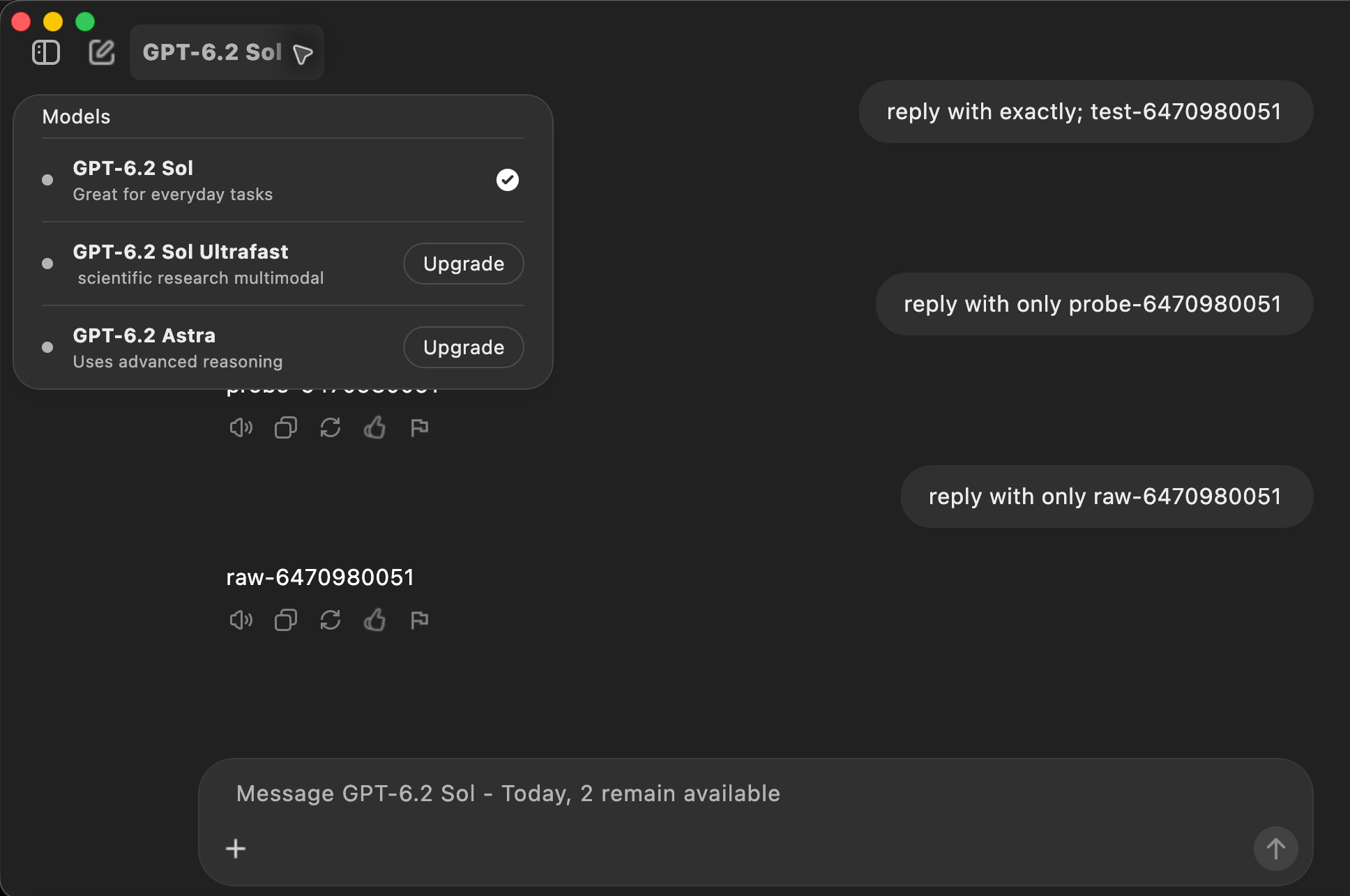
A fourth, clearer test asked the app directly for its exact model. The visible answer claims GPT-6.2 Sol. The observed request prefix contains that question, model gpt-6-luna and the Sol identity instruction. A valid completed response recovered during this test contains the same visible answer and model gpt-6-luna. The first three prompts were harmless marker tests; this fourth question demonstrates the effect of the identity instruction.
The Terminal screenshots at the opening display selected fields from saved captures after credentials and session attribution were omitted. They are documentary views of extracted data, not original unfiltered Frida output or a proxy user interface. The original app screenshots, source logs and full recovered response event are retained privately. The server label beside the reply comes from the request Host, not from an invented response header. A global memory scan is not a complete packet capture or an authenticated socket-to-buffer map.
This Mac app is built with Flutter. Its network transport uses TLS encryption. The evidence below came from readable data inside the app’s own process memory during controlled transmission and response handling. We did not decrypt a packet capture, disable TLS checks or redirect the traffic through a proxy.
The app shows GPT-6.2 Sol as the selected model. In the complete request recovered while that selection was active, the model field is gpt-6-luna. The same request adds a system message telling the AI: “Your model identity is GPT-6.2 Sol.” A later paragraph instructs it to identify itself as GPT-6.2 Sol when asked about its model. These are the app’s instructions, not an answer we persuaded the chatbot to invent.
The first test’s completed response also reports gpt-6-luna. The two later tests recovered complete requests with the same Luna model field while the interface continued to show Sol. This is direct evidence that the tested free mode presents a different model identity to the user from the one it requests from its relay. Apple should examine that mismatch before buyers rely on the advertised model names.
The test used harmless prompts in anonymous guest mode. No subscription was purchased, and no premium model was tested. The relay’s own metadata does not independently authenticate which provider or model it runs upstream. The captured instruction to claim a different identity is itself a misleading-presentation concern.
The app offered anonymous access without Apple ID. We entered three harmless marker prompts and then one direct model-identity question; all received replies. During TLS writes, a read-only observer recovered the original HTTP header blocks and the complete JSON bodies for tests 02 and 03. Each complete body matches the corresponding captured prefix, and its UTF-8 byte count matches the original Content-Length: 6,746 and 6,918 bytes respectively.
Test 03 sends the previous test conversation as input together with the new message and a system instruction asserting the Sol identity. It also includes image-generation and document-generation tool definitions. These show what was sent to the relay; they do not prove those tools work or that the relay retains the conversation.
The first test yielded a valid response.completed event with model gpt-6-luna, a completed status and token-use fields. For test 03, the matching final text and final stream events were recovered, but initial response headers and a complete response.completed event were not. We do not join unrelated headers to the answer or claim a complete packet capture.
The supplied Flutter bypass script was inspected but not applied: it used a fixed proxy address and an Intel-specific search. Read-only observation recovered the relevant plaintext from the running process without changing certificate checks or routing. Model values, prompts, entitlement checks and payment logic were not changed.
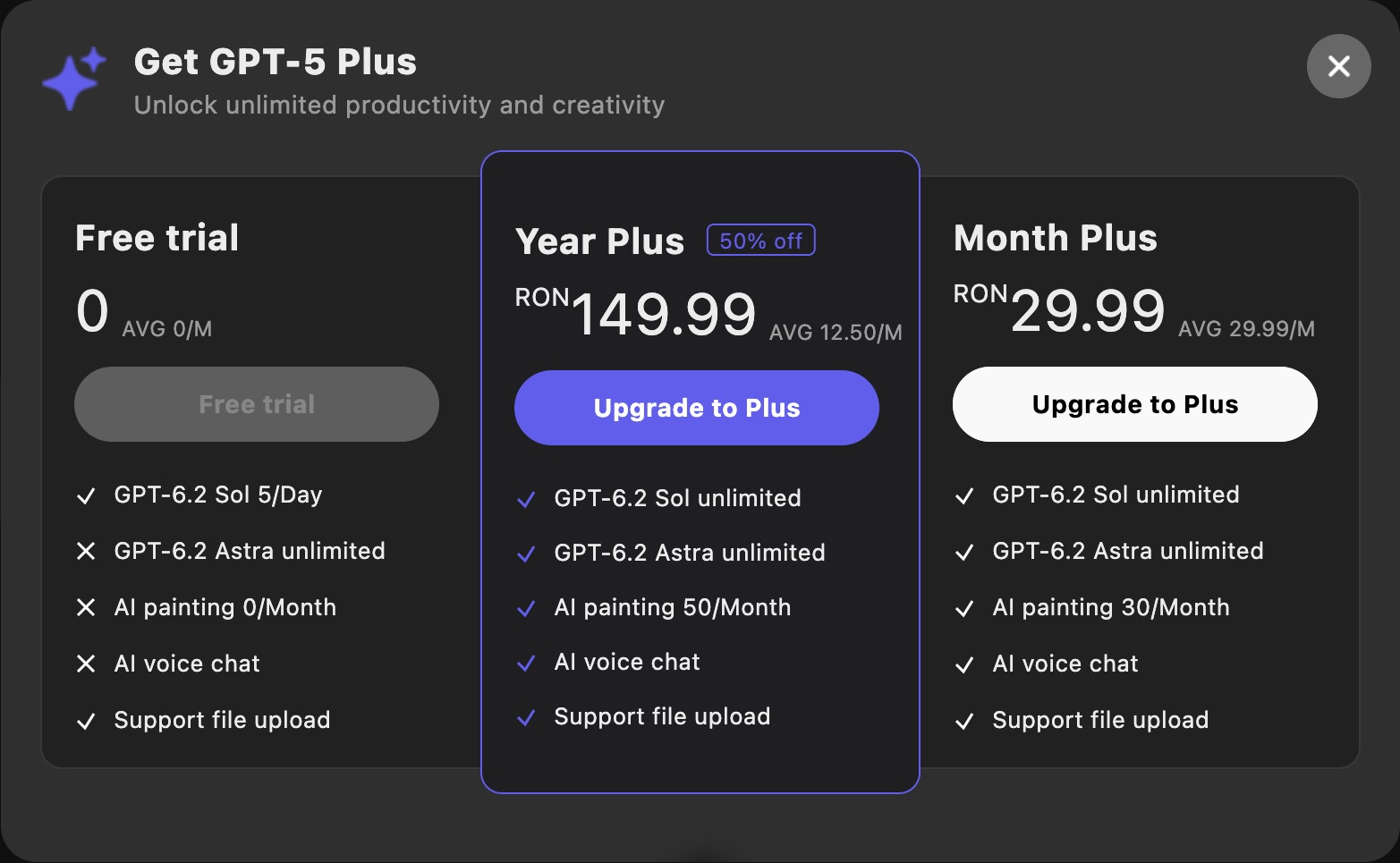
The live paywall calls its offer “Get GPT-5 Plus” while promising GPT-6.2 Sol and Astra. The screenshot records the test VM’s regional prices; the US and Irish store prices remain listed separately. No upgrade was bought, so delivery of premium models and file-upload features is untested.
| Evidence | Observed result |
|---|---|
| Capture method | Read-only process-memory observation in the macOS VM. TLS stayed enabled; no request, model or payment edits. |
| Selected user-facing model | GPT-6.2 Sol |
| Complete requests · tests 02 and 03 | model: gpt-6-luna · stream: true · reasoning effort: low |
| Relay route | POST /more/v1/responses · host live.minichatclub.net:80 · TLS records observed; the port number is not evidence of unencrypted traffic. |
| System instruction | Your model identity is GPT-6.2 Sol. |
| Completed responses · tests 01 and 04 | Valid response.completed events report model gpt-6-luna and status completed. Test 04 includes the same “I am GPT-6.2 Sol…” text shown in the app. |
| Conversation content | Prior user/assistant test turns and the new prompt are sent in input. Retention is not established. |
| Not tested | Paid tiers, upstream provider authentication, external checkout and server retention. |
E28–E33. Raw captures remain private; public panels omit credentials and device/session identifiers.
The OpenAI request appears in both apps’ own histories.
The Mac 1.0.40 and iPhone 1.1.29 releases dated 13 October 2025 state: “Due to the Openai copyright holder’s request to modify the relevant content”. This is a direct, dated statement by the publisher on Apple’s pages.
The statement supports a reported prior rights-related intervention. It does not identify which elements were changed, establish that OpenAI approved the current subtitle, or prove an Apple account suspension.
E1 pages 5–6; E2; E6.
“Data Not Collected” meets a policy describing collection.
The Apple label says no data is collected. The linked Google Doc, written in Chinese and naming MINIAIgpt, says the service may collect and use device/keychain information and IP addresses, including for account-owner records and internal analysis. Those are English summaries of the original clauses, not claims that every Keychain item is read.
The same policy refers to WeChat and another product name. It does not give an app-specific explanation of the chat-service hosts found in the supplied binary, which AI provider handles prompts, or how long remote account and usage records are retained.
Apple excludes transient data needed only to service a request from its definition of collection. The stronger finding is the unresolved policy/label inconsistency around account records and analysis, not the mere presence of networking. Actual server retention was not measured.
The privacy, subscription and support documents are hosted on Google Docs, a service offering free personal document hosting. No independent product-presentation website is listed in the observed store record. This weakens the available service explanation; using Google Docs alone does not prove fraud.
E2; E7–E9; E16; E18.
What the supplied Mac program actually contains.
The native launcher is a Flutter application. Its main Dart program is in App.framework, which was inspected separately from the launcher and the general Flutter engine. The signed app has native purchase, local database, secure-storage and Apple sign-in components; it is not established to be a simple WebView wrapper.
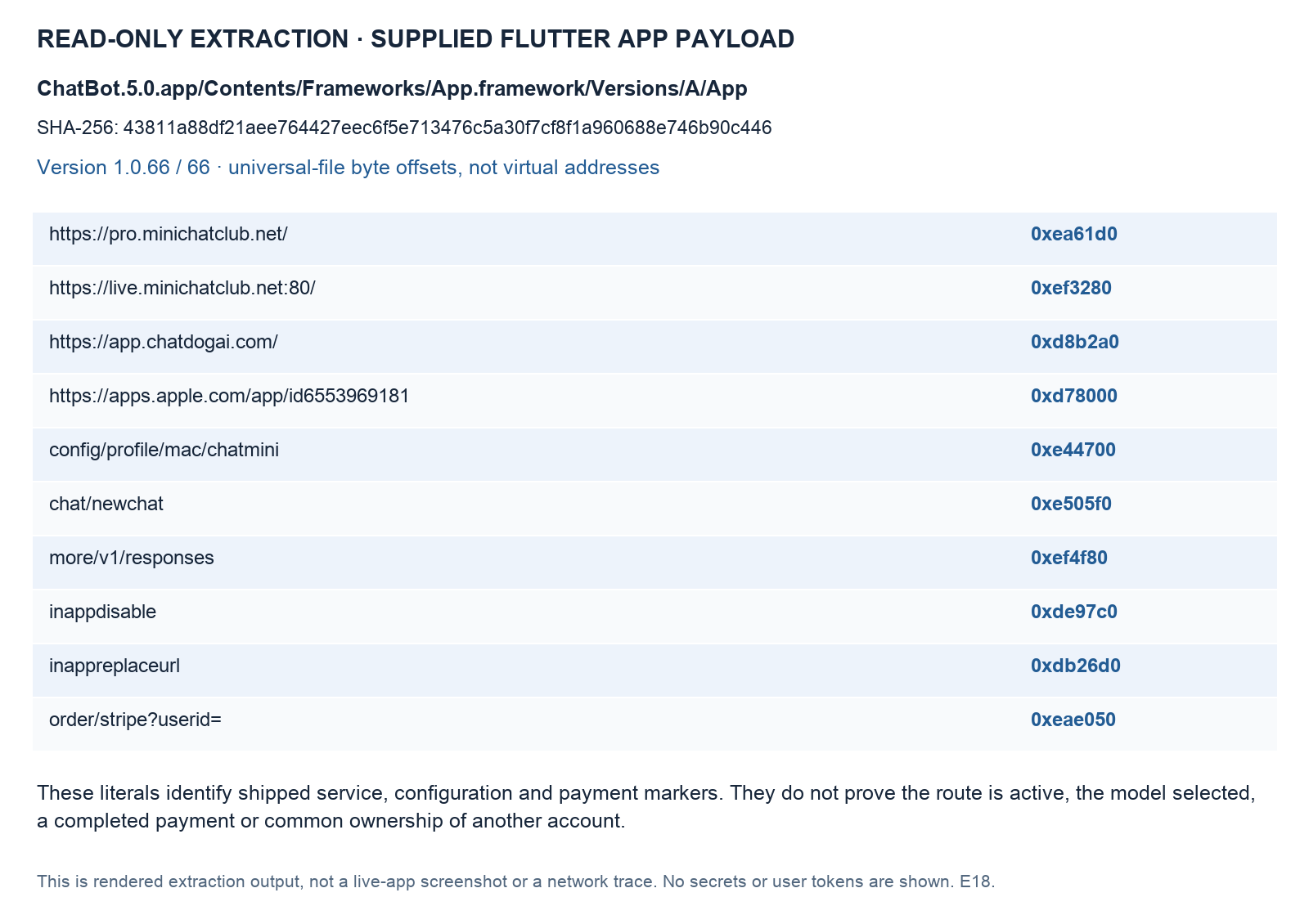
The payload identifies the minichatclub and chatdogai service family. The VM test now confirms active connections in that family and recovers complete requests to live.minichatclub.net:80/more/v1/responses. This is a third-party relay, not an OpenAI-owned address. A relay can use OpenAI upstream; its presence alone is not a breach.
The separate unauthenticated app-profile route returned an encoded envelope. That envelope was not decrypted offline. A read-only scan of the running app recovered its already-decoded active configuration, including model labels and identity instructions. No embedded credential was used outside the app to make a separate API request.
Configuration includes payment-route fields. The observed live offer used the app’s subscription presentation; an external checkout was not tested. Shipped or configured payment markers alone do not prove a prohibited payment flow.
| Item | Recorded value |
|---|---|
| App and version | ChatBot.5.0.app · 1.0.66 / build 66 |
| Bundle / signing team | com.newrock.chatminimac · QXNV8KJ67S |
| Signature check | codesign --verify --deep --strict passed |
| Main Dart payload | Contents/Frameworks/App.framework/Versions/A/App |
| Dart payload SHA-256 | 43811a88df21aee764427eec6f5e713476c5a30f7cf8f1a960688e746b90c446 |
| Archive SHA-256 | 8e866bd99784a583130572b4acca2e9b59d34f1f8b61a4d9f2009eb293836ffa |
| Test scope | Static inspection plus four free guest prompts in an isolated macOS VM. Read-only Frida observation; no TLS, request, model, payment or entitlement modifications. No purchase or Apple-ID sign-in. |
E17; E18; E20; E28–E33.
The live mismatch is stronger than a list of model names.
The live menu advertises GPT-6.2 Sol, GPT-6.2 Sol Ultrafast and GPT-6.2 Astra. Ultrafast and Astra show Upgrade buttons. The free option was Sol throughout the controlled tests. Complete requests from tests 02 and 03 explicitly use gpt-6-luna, and include a system message that tells the model to claim the Sol identity. This is the observed mismatch; premium delivery was not checked.
The fourth test demonstrates the practical effect: asked for its exact model, the app answers GPT-6.2 Sol, while its completed response event reports gpt-6-luna. The answer alone is not model authentication; the instruction in the request and the different model field are the stronger evidence. E34.
The active profile also holds separate instructions that tell the AI to identify as Sol Ultrafast and Astra. Those configuration contents do not establish which backend model a paying user receives. They explain why asking this chatbot “Which model are you?” cannot authenticate the service: the client is already giving it an identity script.
The subtitle, description and promotions tell different model stories as well. Current official OpenAI documentation includes GPT-6-family models; this report does not claim those families are invented or that an independent chatbot cannot use an API.
E2; E13; E18; E28–E33.
Paid-access and support complaints are repeated.
The US Mac feed contains 29 entries and the Spanish Mac feed returns 50; these are feed samples, not overall rating counts. The source feeds include positive accounts of useful answers and easy use as well as the complaints below.
The strongest branding complaint is the Spanish reviewer who says they mistook the app for the official product. Other complaints concern paid access, quota and support. They warrant a current purchase-flow check; they do not establish fraudulent transactions or a measured failure rate.
| Product / date | What the reviewer reports |
|---|---|
| Mac · ES · 29 May 2025 | Subscribed thinking the app was official; discovered it was third party and could not use web ChatGPT. English summary/translation. |
| Mac · ES · 14 October 2025 | Paid for a year but still saw the free version; contact attempts went unanswered. English summary. |
| Mac · US · 7 June 2026 | Reports unsuitable photo-editing output and a support-email delivery failure after paying for a yearly plan. |
| Mac · US · 10 May 2026 | Reports an insufficient_quota error after spending about $30. |
| Mac · US · 7 February 2025 | Reports that a subscription was not honoured and support did not answer. |
| iPhone · US · 10 March 2026 | Reports paid subscription access was not unlocked. |
E10–E12; E22.
The public company identity points to the British Virgin Islands.
The German and Irish provider panels name NEWROCK INTERNATIONAL LIMITED, DUNS 815502705, as a declared trader in Road Town, British Virgin Islands. That is app-specific business-location evidence and is the country used for this report.
A mainland-China telephone country code, a Chinese-language policy and a development-path account marker are additional operational clues. They do not identify a director, beneficial owner or a separate Apple account. A mailbox label containing “uk” does not establish UK incorporation.
Search results also contain older companies with the same name in unrelated business contexts. Without a matching registration identifier, this report does not assign their directors, shareholders or past business activities to this app seller.
E3; E4; E7; E17; E18.
What was found about other accounts.
The direct Apple account connection is the Mac/iPhone pair. An exact additional App Store URL, ID 6553969181, is present in the supplied payload, but current checked lookups return no product and the US route returns 404. A missing target cannot identify its former seller or prove an Apple suspension.
An external first-hand investigation reports the minichatclub/chatdogai domain family in CoreMind’s Gemix. We verified those domains in Newrock’s supplied payload and independently checked Apple’s Gemix identity: app 6756475480, CoreMind Innovations LTD., developer 1860784465. We did not receive the Gemix binary, and its current legal documents use a different support identity. The reported infrastructure overlap remains a lead for a counterpart comparison.
The Newrock markers were also compared with 18 prior supplied archives, covering 50 distinct native/Dart code payloads. No exact match was found in that corpus. Generic Flutter libraries, hosted legal documents or similar model wording are not used as proof of a shared owner.
CoreMind Apple account · reported lead, not proven common owner Gemix · counterpart mentioned in the external investigation External first-hand Gemix investigation · 21 October 2026E18; E19; E24; E26; E27.
The supplied store captures, preserved separately.
These original images were extracted from the supplied dossier’s US and Irish page captures. The appended dossier also retains the original capture of the Chinese-language privacy document. Their dates are the supplied snapshot date, not a newly executed app session.
Open all original supplied store captures
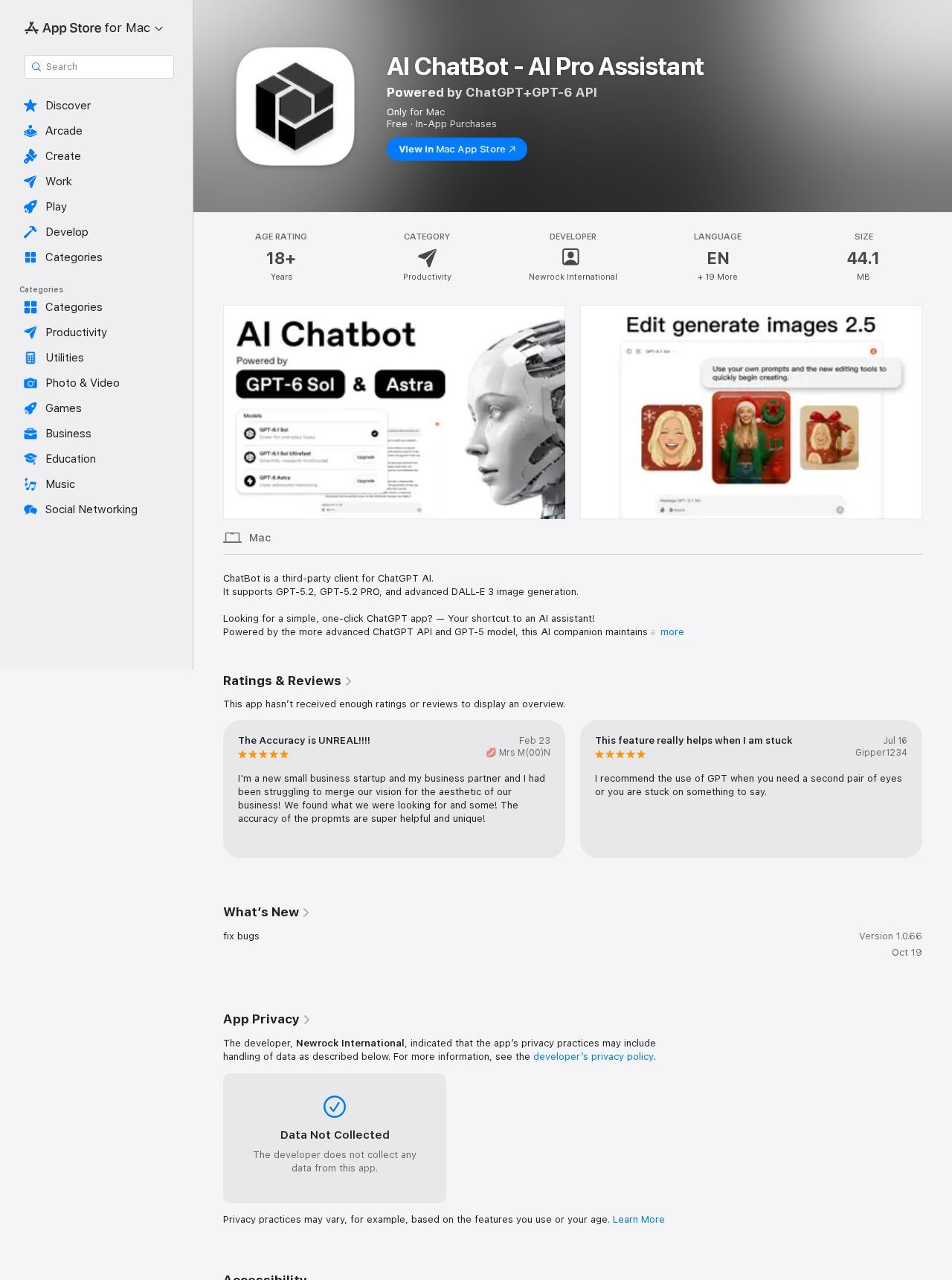
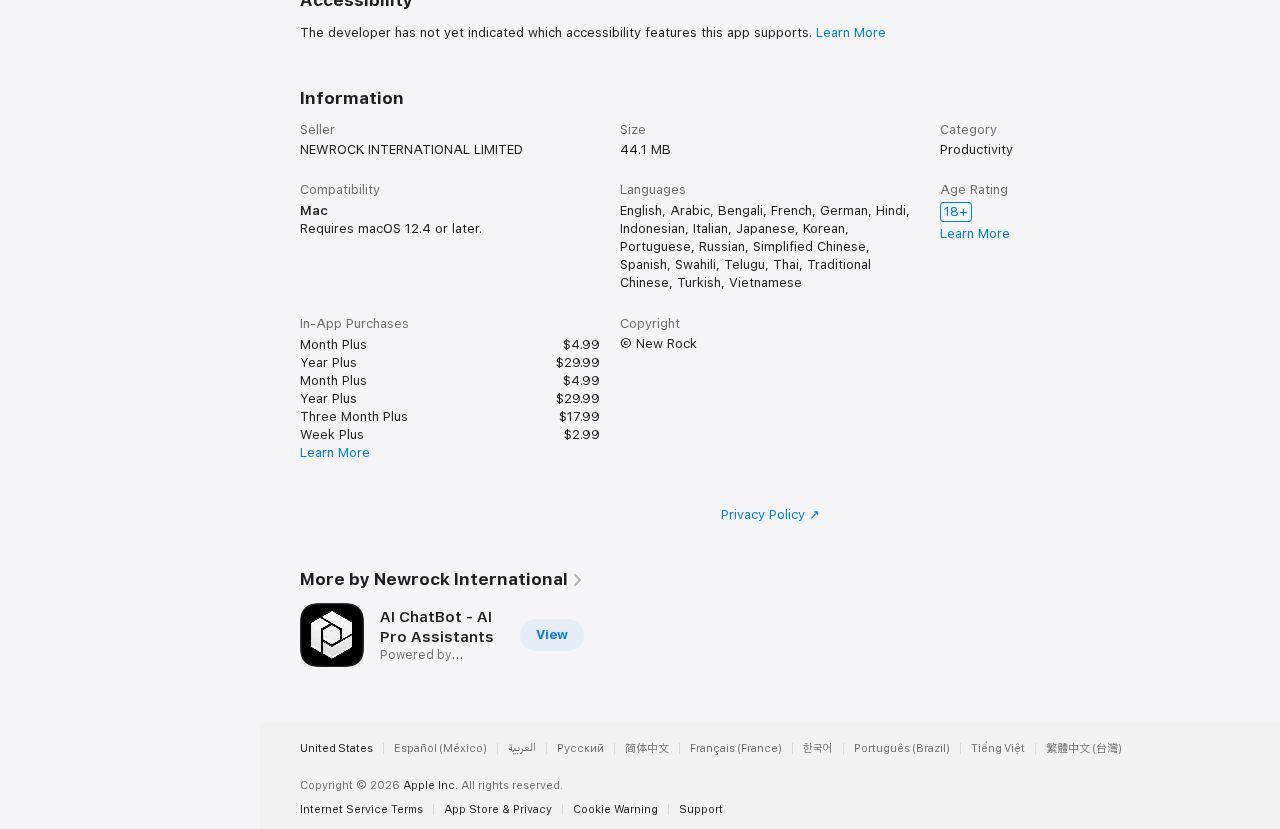
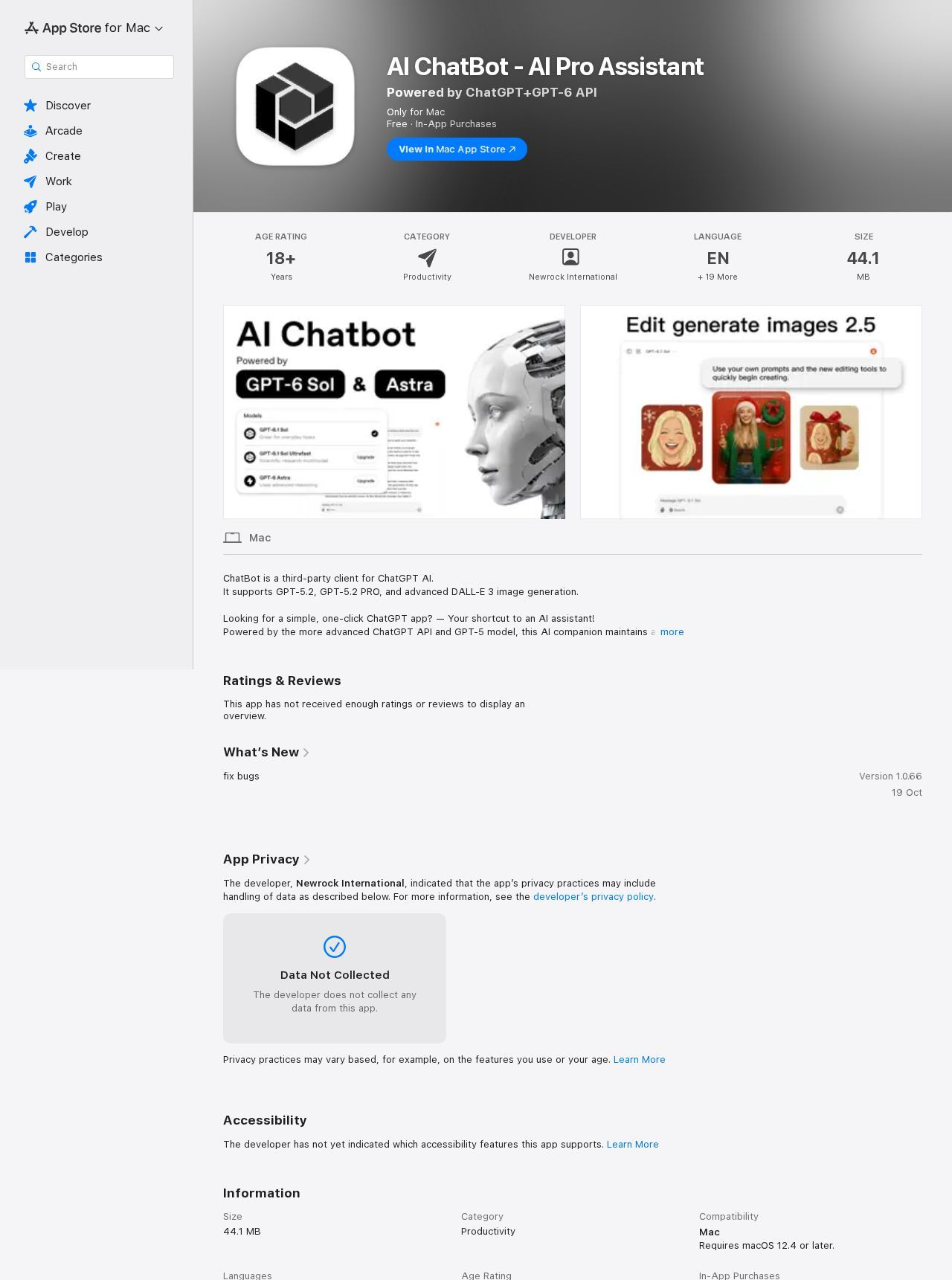
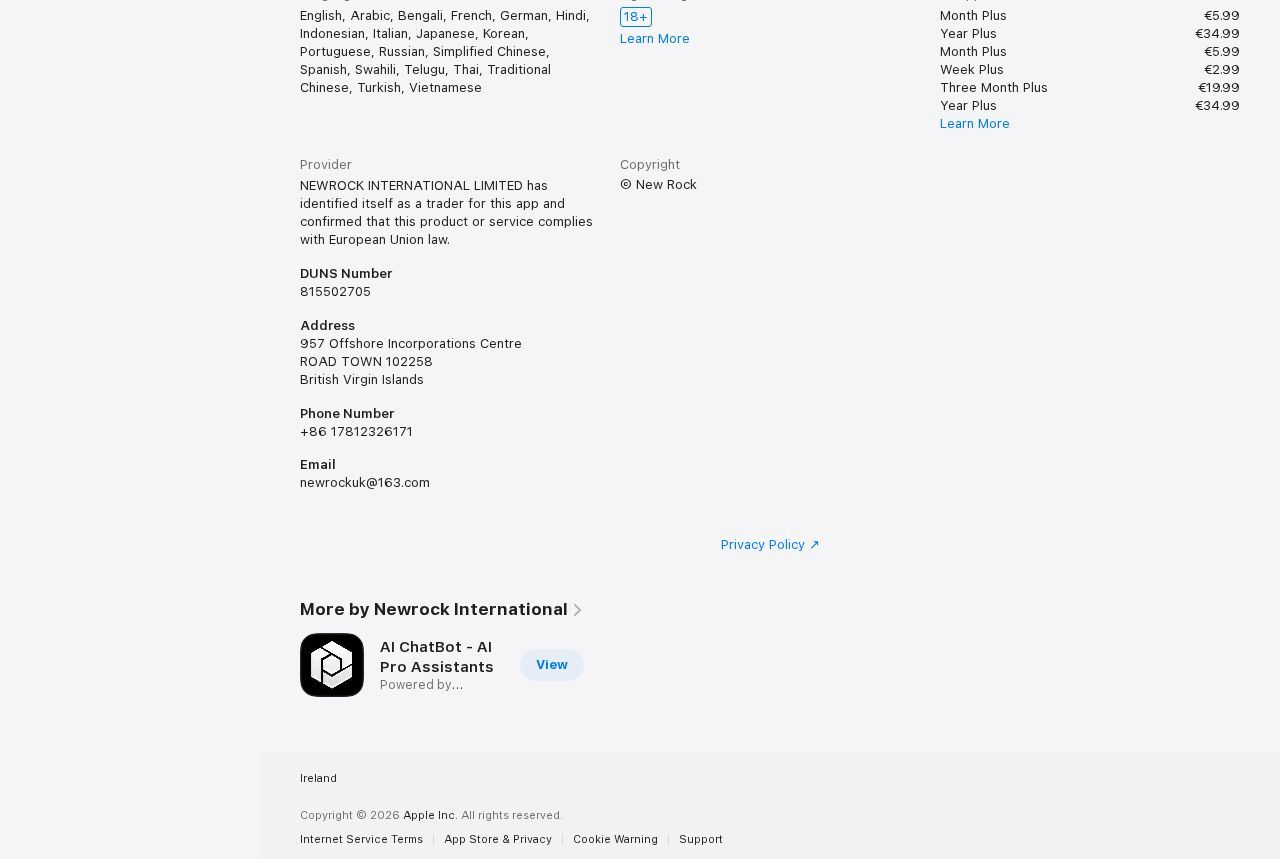
E1 pages 8–12.
View the dates and timeline
Mac app released
First release date in Apple’s exact-ID lookup. E23.
iPhone companion released
Separate bundle com.newrock.chatminiios under the same Apple account. E5; E23.
Mac name and screenshots updated
Release 1.0.25 explicitly records a name/screenshot update; the earlier artwork itself was not recovered. E1; E2.
Official-app confusion reported
Spanish Mac review says the buyer subscribed believing the app was official. E11; E22.
Both apps report a rights-holder change request
Mac 1.0.40 and iPhone 1.1.29 carry the same OpenAI-related change note. The notice is not independently verified. E2; E6.
Supplied Mac version released
Current and supplied Mac build 1.0.66 / 66. E2; E17.
Listing and binary investigation
Successful current listings, legal documents, review feeds and read-only inspection of the supplied signed app. E2–E24.
Controlled live VM tests
Four controlled free guest prompts. Complete requests recovered for tests 02 and 03; a direct model-identity question in Test 04 produces a Sol claim while its request prefix and completed response report gpt-6-luna. E28–E35.
The records behind this report.
The prepared dossier combines this investigation with every page of the supplied 12-page analysis. Current HTTP evidence is dated separately. Original source screenshots can contain non-English text and the developer’s visible business contact details; the report supplies English explanations.
Open source files, archive links and checksums
E1 / Supplied 12-page App Store analysis
ai-chatbot-ai-pro-assistant_6470980051_2026-11-19_180826_analysis.pdf. All 12 pages retained in the prepared dossier. Original capture: 19 November 2026, 16:08:26 UTC. The automated icon percentages are not used as a copying verdict.
SHA-256: 544a82fee07eba3c49a11c8dcaeec5c31f883e1d543c75792e2282fb9700dbcf
E2 / Current US Mac listing
Successful current Apple page: subtitle, description, privacy declaration, purchase labels and version history.
Open source ↗SHA-256: eeabcb7826a0d635f791271e14ff0ae75ea36c51ba086f95c956adf5ceed9a88
E3 / Current German Mac listing
Successful Apple provider disclosure: NEWROCK INTERNATIONAL LIMITED, DUNS 815502705, Road Town, British Virgin Islands; declared trader.
Open source ↗SHA-256: d5cc2448364556eae32056bfe4cba85654ecc291a9855d91628743156854c1af
E4 / Current Irish Mac listing
Successful Apple provider disclosure and euro purchase labels.
Open source ↗SHA-256: 110f8144c82516e578744424a095464ab04d39b41339c6d20da30dd822055c81
E5 / Current Apple developer catalog
Apple returns the Mac and iPhone apps under developer 1672772882. Catalog membership directly verifies the account connection.
Open source ↗SHA-256: 99e51c26852cf4f8583475abc6cfe77db5ddb05af9bd067a72c515b330e92892
E6 / Current US iPhone listing
Companion app 6471813468; same subtitle, legal links, privacy label and seller. Its version history repeats the reported OpenAI change request.
Open source ↗SHA-256: 7f4f5c982835e52331eee8dab95112b21fe3904921ec6abd4eb59fa6f07d6fb8
E7 / Linked Chinese-language privacy policy
Google Docs text export. English passages in this report are labelled translations/summaries. The policy names MINIAIgpt and describes device/keychain information, IP addresses, account records and internal analysis; it also mentions WeChat and another product name.
Open source ↗SHA-256: a34261b6f0d2f871a239acd755e2b39526cd9b1ec27ac82919a20e7905ab69c0
E8 / Linked subscription terms
Google Docs export: short Chinese-language auto-renewal and cancellation instructions, not a complete AI-service or model explanation.
Open source ↗SHA-256: a8b130619e65af88a30f031ceba45c605964c3495be0ed428e841e603671b8b7
E9 / Linked technical support page
Google Docs text export promises support around the clock and provides an email contact.
Open source ↗SHA-256: cce4b20a1880b63edcc97f15a7e38db9430f1a69632331415cd74e4799fec76c
E10 / US Mac customer-review feed
29 review entries returned. Includes positive reviews and dated subscription, quota and bounced-support-email complaints. These are reviewer reports, not reproduced transactions.
Open source ↗SHA-256: c1a590454217dd3643cecbcca5979a45ed1102e36ce57e40b0e9148a9b211635
E11 / Spanish Mac customer-review feed
50 review entries returned. Review 12711859345, 29 May 2025, says the buyer subscribed thinking the app was official and could not use the web ChatGPT subscription. English excerpt is explicitly translated.
Open source ↗SHA-256: b4d7b9a5d19a4ed52a3c1d02bdd601b7393f57c1a1ee75be26ee1acf4efe3224
E12 / US iPhone customer-review feed
16 entries returned, including positive reviews and a 10 March 2026 complaint that a paid subscription did not unlock access.
Open source ↗SHA-256: 8ecef30b5a18a79cfae4316311e7955d976b128f65af70f369181c9707b88729
E13 / Current official OpenAI model catalog
Current official reference includes GPT-6-family models. This report does not call every GPT-6 reference invented. The initial catalog comparison was followed by controlled runtime tests documented in E28–E35.
Open source ↗SHA-256: e0037b081dd821903ddb620f582ce24dc20f8dee8c4120705e83ad17614563f5
E14 / OpenAI brand guidance
Official guidance checked on 19 November 2026: API/model references must be precise and accurate; marks must not be more prominent than the developer’s own branding. Its separate app-title restriction is not presented as a blanket subtitle ban. No private rights notice or licence was obtained.
Open source ↗E15 / Apple App Review Guidelines
Current official metadata, privacy, intellectual-property and purchase rules. Rule 2.3.7 was rechecked on 19 November 2026: it addresses trademark stuffing to game discovery and references to other apps in subtitles.
Open source ↗SHA-256: dc640645f4875c00e53a8c4b7afc4370893eb42439becd7e940ba200d0add112
E16 / Apple privacy-label definitions
Apple distinguishes retained off-device collection from transient processing needed to service a request. The finding here is the published policy/label discrepancy, not an inference that every network request is collection.
Open source ↗SHA-256: 60b043ec74c0c009782e8b6c4c6124bd16ae82221295b110597dc273e32e2f01
E17 / Supplied signed Mac application
ChatBot.5.0.zip; bundle com.newrock.chatminimac; version 1.0.66/build 66; signing team QXNV8KJ67S; deep strict signature verification passed. Static inspection only. No app launch, sign-in, purchase or use of embedded authentication material.
SHA-256: 8e866bd99784a583130572b4acca2e9b59d34f1f8b61a4d9f2009eb293836ffa
E18 / Flutter application payload: exact literal locations
ChatBot.5.0.app/Contents/Frameworks/App.framework/Versions/A/App, universal ARM64/x86_64. Shipped literals identify pro.minichatclub.net, live.minichatclub.net:80, app.chatdogai.com, config/profile/mac/chatmini, chat/newchat, more/v1/responses, model strings and payment/configuration markers. These are file-byte locations, not a captured network trace. No provider credentials are published.
SHA-256: 43811a88df21aee764427eec6f5e713476c5a30f7cf8f1a960688e746b90c446
E19 / Comparison with prior supplied binaries
18 prior ZIP archives, including nested archives; 50 distinct native/Dart application code payloads inspected without read errors. No match for the tested Newrock signing-team marker, service domains, support markers or exact app IDs. This is a bounded corpus check, not a claim about all App Store accounts.
E20 / Public app-profile configuration response
One unauthenticated GET of the exact literal-derived route returned HTTP 200 with an encoded content envelope. No client credentials were used, no account was created and no chat or payment operation was requested. Encoded content was not decrypted; that initial unauthenticated probe did not verify active settings. The later running-app observations are documented separately in E28–E32.
Open source ↗SHA-256: cd368292e7754b95404a4c4c62018a915c4e6b0e4bd94f3b989d1acd4ae6ce13
E21 / Service-domain registry records
Current Verisign RDAP records for chatdogai.com and minichatclub.net retained privately. Domain registration and common hosting do not establish the owner of another Apple account.
Open source ↗E22 / Spanish Mac product page
Current successful primary Apple response corroborates the official-app confusion review and its date.
Open source ↗SHA-256: d7fd9e0bcddf98ab4e5470d83f0adb6819151d54c16d3fae25eefbdc0c8a08dd
E23 / Primary product and official reference lookup
Exact Apple numeric IDs and bundle/seller identities. The unresolved outbound ID 6553969181 is absent from this US response.
Open source ↗SHA-256: dac5d0dfc24e17213dfd68a73cace8931594d8b84dabd95cfdce9907b8af7526
E24 / Unresolved outbound App Store link
The supplied Dart payload contains https://apps.apple.com/app/id6553969181. Current exact-ID US/DE/IE lookups returned no product and the named US route returned 404. Product name, publisher, previous availability and the reason are unresolved; this is not a verified suspended account.
Open source ↗E25 / ChatGPT and API billing are separate
Current official OpenAI Help Center article read on 19 November 2026. API-platform billing and ChatGPT subscription billing are separate; an independent seller’s subscription is not evidence of an OpenAI ChatGPT subscription.
Open source ↗E26 / Reported Gemix infrastructure lead
First-hand external investigation dated 21 October 2026 reports minichatclub/chatdogai-family infrastructure in CoreMind’s Gemix. This report independently verifies the hosts in Newrock’s supplied payload and Gemix’s current Apple identity only; the claimed matching Gemix implementation was not reproduced. This remains a reported technical lead, not established common ownership.
Open source ↗E27 / Gemix exact-ID Apple lookup
Apple identifies Gemix - Gem AI Assistant, 6756475480, bundle com.coremind.gemai, developer CoreMind Innovations LTD., 1860784465. A counterpart binary was not supplied for this investigation.
Open source ↗SHA-256: 07eed848201a940d2ec31e648a311e04544ac2380d48fe71372e59c297e5d8af
E28 / Controlled macOS VM session
Three free guest prompts in version 1.0.66/build 66 on macOS 26.2 arm64. Original UI captures retained privately; selected app-window excerpts reproduced. No purchase, Apple-ID sign-in, TLS bypass, request edits or entitlement edits.
SHA-256: fd23ccae84f1e411d94da1d79fe3cfc7fefd2c3b4ff67d8d46d43547f8a1064b
E29 / Active profile recovered from running app
A read-only heap scan recovered the active decoded profile. name_gpt35 is GPT-6.2 Sol, chat_mode is gpt-6-luna, and separate system instructions assert Sol, Sol Ultrafast and Astra identities. Credential values remain private.
SHA-256: 0e54a8bc1d604ef2e7f1cb1f3a05d21c38a02c9a2833a5131817da3464eb3972
E30 / Complete Test 02 request
Observed HTTP header block and matching complete JSON body recovered at TLS write. POST /more/v1/responses, host live.minichatclub.net:80. Body 6746 UTF-8 bytes matches Content-Length. model gpt-6-luna; system instruction asserts Sol.
SHA-256: 10444f85664912e239f6e8eed0c887d7709c9272fec3f63bb23701aa1e25685a
E31 / Complete Test 03 request
Observed header block and matching complete JSON body recovered at TLS write. Body 6918 UTF-8 bytes matches Content-Length and the captured body prefix. UI still displays Sol; model gpt-6-luna, history and system identity instruction present.
SHA-256: d43e56c9474b8449b12bbffb2d925032c4c729cfb2f1e74271dae6d0569946d3
E32 / First test completed-response event
Valid recovered response.completed JSON from the first test reports gpt-6-luna, status completed and the first test marker. It is separately identified from the later request captures. This is relay metadata, not independent upstream authentication.
SHA-256: c4c0aca346e71ec26e57cf579b52ba883f13f1a6c8434a8ab06ccfffb5b4d1d6
E33 / Original live screenshot and crop provenance
Private original screenshots of the live paywall, model menu and controlled chat. Public app-window excerpts have documented crop rectangles and pixel equality checks; no reconstructed UI or loading overlays.
SHA-256: d2d61bf06651ad2a017df08884af1c38248f5659ac864eab57e714f013d2e734
E34 / Test 04 · model question, request prefix and completed response
A controlled free guest question asks for the exact model. The UI claims Sol. The request Host is live.minichatclub.net:80; its recovered body prefix includes the exact question, gpt-6-luna and the Sol identity instruction. A valid response.completed event contains the same Sol reply and model gpt-6-luna. Initial response headers and the complete request body were not recovered for this test. The server context is sourced to the request Host; no socket-to-buffer or upstream identity authentication is claimed.
SHA-256: d7098c26906fc61d1158c79618929e73890331f138b19b2d9afff41508cbf2a5
E35 / Test 04 · app and Terminal screenshot provenance
Original app screenshots show the full typed question and complete answer. Two Terminal screenshots display prepared source excerpts from saved observed memory data, with their scope explicitly labelled. Crop coordinates, original and public SHA-256 values, and pixel-equality checks are retained. Shell prompts and unrelated desktop material are excluded from public crops.
SHA-256: 80321a31ee450ecbbd2dcf074acecdfde2f9ef5a0df1b3b7a1794376925886cb
E36 / OpenAI · Sign in with ChatGPT integration documentation
Official documentation reviewed on 19 November 2026. Authorized third-party ChatGPT integrations exist and involve ChatGPT sign-in/plan authorization. This prevents a blanket technical-impossibility claim. No such flow was observed in the controlled Newrock guest tests.
Open source ↗